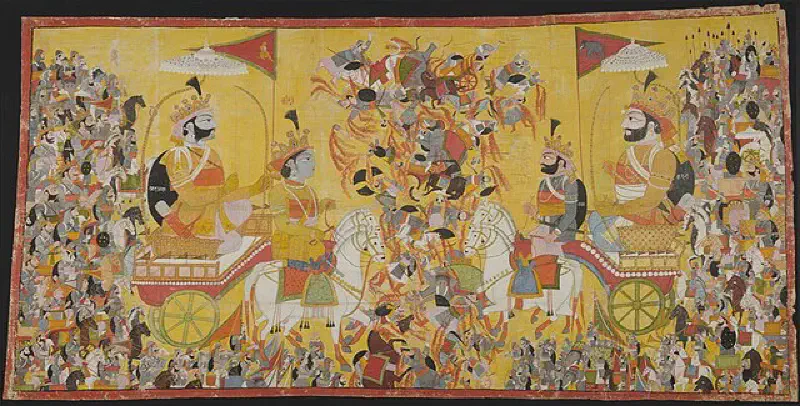
Karna watched the sun climb over the horizon. Its light touched his face, but he felt no warmth.
The war had dragged on too long. He had done things that made him sick with shame.
Abhimanyu’s death haunted him. The boy’s face came to him in dreams—young, fierce, unafraid. Dead now. Dead by his hand, among others. He had killed his nephew. Tomorrow he would face the boy’s father, Arjuna. His own brother. His hands trembled at the thought.
A tear rolled down his cheek. Then another.
How had it come to this? He, who had always prided himself on his honor, who gave away anything asked of him, who never turned away a supplicant—he had become this. A killer of children. A man who fought without honor, who surrounded a boy and cut him down like dogs tearing at a cornered deer.
He sensed a presence and turned. Krishna stood there, calm as still water, watching him with those dark, knowing eyes.
“Why?” Karna’s voice broke on the word. Krishna sat beside him and placed a hand on his shoulder. That simple touch shattered something in Karna. He wept like a child, his shoulders shaking, all the grief and shame pouring out of him.
“Why, Krishna? Why do we do evil things? Why do we leave the path of dharma?” The words came in gasps. “Why did I help kill that young lion? Why did I listen to Drona and cut Abhimanyu’s bowstring? Why?”
He looked at Krishna, his face wet with tears. “I knew it was wrong. Even as I did it, I knew. I heard the voice inside telling me to stop, to walk away. But I didn’t listen. I didn’t listen, Krishna.” Krishna let the silence settle. When he spoke, his voice was gentle but firm.
“Don’t blame Drona for what you chose, Suryaputra. You were angry. Your pride was wounded because Abhimanyu bested you again and again. A boy, barely sixteen, and he made you look like a novice. You let anger in. You let envy in. They clouded your mind and you forgot who you were.”
He paused. “This is your ruin, my friend—this anger, this envy. You are one of the greatest warriors alive. You know dharma. You are brave. You are generous and kind. But there is darkness in you, as there is in all people. The difference is that good people fight it. When anger takes you, when envy speaks, you forget the good. You let the darkness win. That is the battle you must fight, Karna. The one within yourself.”
Karna wiped his eyes. “I have lost that battle, Krishna. I lost it long ago.”
“Perhaps. But knowing you have lost is the first step to winning it again.”
They sat in silence for a while. Then Krishna rose.
“I must go,” he said softly. “The day awaits us all.”
Karna looked up at him. “Will you… will you tell Arjuna? That I am sorry? That I loved Abhimanyu like my own son?” Krishna’s eyes held infinite sadness. “Some things cannot be unsaid, Karna. Some wounds cannot be healed with words. But I will tell him you asked.”
He walked away, his yellow silk catching the first rays of the sun. Karna watched him go until he disappeared among the tents. Then he was alone again with his anguish.
He sat for a long time, remembering. Abhimanyu’s laugh. The way the boy had looked at him once with respect, before the war, before everything turned to blood and ash. The brightness in those young eyes. Gone now. Snuffed out.
He saw Abhimanyu’s face again—so like Vatsala’s son might have been, if fate had been kinder. His nephew. Almost his son. And he had killed him.
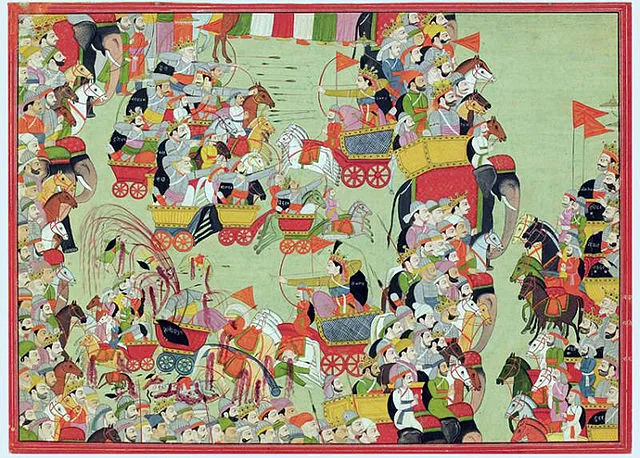
The memory of it burned. The chakravyuha closing around the boy. Abhimanyu fighting like a demon, his sword flashing, his arrows finding their marks even as his weapons broke, even as his chariot shattered. And then that moment—that terrible moment when Karna had raised his bow and cut the boy’s bowstring from behind.
He had watched as the others closed in. As they beat the boy down. As they killed him while he fought with a broken chariot wheel, alone and surrounded.
Karna had stood and watched. He had done worse than watch—he had helped.
The shame of it was like poison in his blood.
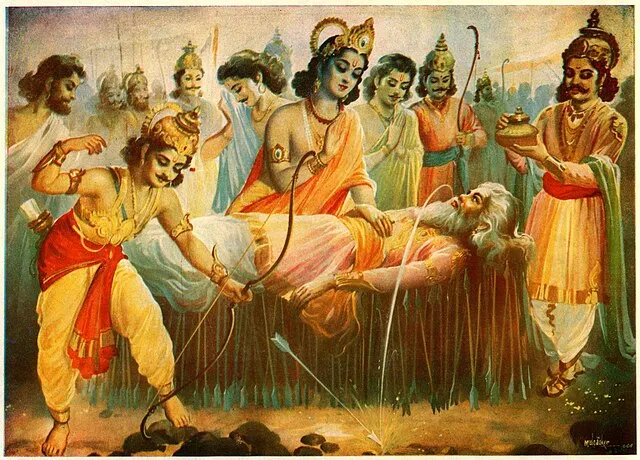
All the elders were gone now. Bhishma lay on his bed of arrows, waiting for death
🙏 Namaste