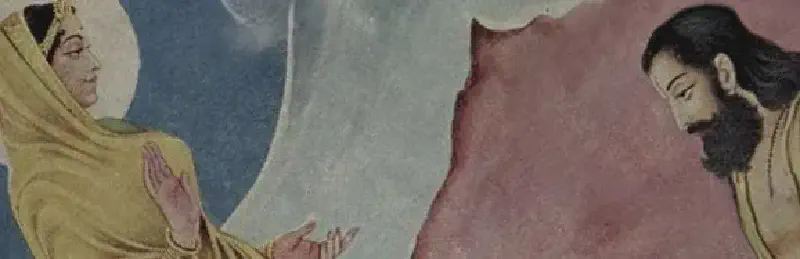
Rishi Kaushika was, by all accounts, a remarkable man. He had been sitting in meditation for years. Years. No Netflix, no chai breaks, no idle gossip with neighbours. Just him, the forest, his breath, and the slow, burning accumulation of spiritual power. He could feel it humming in his bones like a second heartbeat.
Naturally, he was a little pleased with himself.
Okay — very pleased with himself.
He had the quiet confidence that only comes from decades of discipline. The kind that makes a man walk just a little slower than necessary, chin slightly lifted, eyes carrying that serene half-smile that says: Yes, I have figured things out. You are welcome.
One afternoon, he sat beneath a large tree, deep in meditation, when… Splat.
Something warm and distinctly unpleasant landed on his head.
He opened one eye. Then the other.
Above him, completely unbothered, sat a crane. The bird looked down at the sage with the casual indifference that only birds and cats can manage.
Now, a more ordinary man might have wiped his head and muttered something under his breath. But Kaushika was not an ordinary man. He was a powerful sage. And powerful sages, it turns out, do not take kindly to being used as target practice. He looked up at the crane with eyes blazing.
The crane dropped dead. Just like that. Fell straight down and landed at the sage’s feet with a soft, final thud. Kaushika stared at it. The forest went very quiet. “Oh,” he thought.
The pride that had been sitting so comfortably in his chest suddenly felt a little heavier. He had killed a living creature, not in self-defence, not for food, but because his ego had been ruffled by a bird doing what birds do.
Meditation ruined, conscience stinging, he bathed in the river and walked toward the nearest village, telling himself that some fresh air and a warm meal would set things right.
He stopped before a modest house and called out in the traditional way — “Bhavati Bhiksham Dehi!” — which roughly translates to: “Oh mother of the house, please give this holy man some food.” A woman’s voice floated out from inside. “One moment, please.”
Kaushika straightened his robes and waited. He waited some more. Then a little more.
The sun moved. Somewhere, a cow mooed philosophically. The sage’s stomach growled. His patience, never his strongest quality even on good days, began to fray at the edges.
Who makes a sage wait? he thought. Does she not know who I am?
By the time the housewife finally appeared at the door — carrying a plate of food, face calm, completely unhurried — Kaushika’s eyes had taken on that particular reddish tint that had recently proven fatal to a crane.
He looked at her. She looked at him.
Then she smiled, not nervously, not apologetically, but with the warm, serene smile of someone who is entirely at peace with herself.
“I am not a crane, Rishi Kaushika,” she said pleasantly. “Your eyes won’t work on me.”
The plate nearly slipped from Kaushika’s hands. He looked left. He looked right. There was nobody else around. The forest incident had happened miles away, witnessed by absolutely no one — or so he had thought.
“How do you—” he began. “Know?” she finished, still smiling. “Please sit.”
She explained, without even a trace of arrogance — which made it somehow worse — that she had not spent years in a forest. She had not performed great penances or sat in long meditation. She had cooked, cleaned, argued with vegetable vendors, nursed a sick husband, raised children, and tried her very best to do every small thing with care and love.
“I was late,” she said simply, “because my husband needed me. That is my dharma, my duty. And when you perform your duty with a full heart, without complaint, without shortcuts — something opens up inside you. Call it wisdom. Call it clarity. Call it whatever you like.”
Kaushika, who had burned a bird with his gaze twenty minutes ago, found he had absolutely nothing to say. “There is a man in Mithila,” she continued, refilling his water. “His name is Dharmavyadha. Go meet him. He will teach you more than any forest can.”
Mithila was a busy, cheerful town. Kaushika arrived expecting to find Dharmavyadha in a quiet hermitage, or perhaps leading a school of earnest young students. He asked around — at temples, at the homes of scholars, at the gates of the learned.
“Dharmavyadha?” said a man, scratching his chin. “Oh yes, a wonderful fellow. He’s at the market. The meat market. He’s the butcher.” Kaushika blinked. “The… butcher.” “Big stall, third lane. You can’t miss the smell.”
The great sage, a graduate of decades of forest austerities, capable of incinerating birds with a glance, found himself standing awkwardly in a busy meat market, trying not to look too horrified, while a cheerful, broad-shouldered man efficiently went about his business with a cleaver.
This was Dharmavyadha. He looked up, grinned, and said: “Ah! The sage from the forest. The housewife sent you, didn’t she? Come, come — let me finish this order and we’ll talk.”
Kaushika opened his mouth. Closed it. Opened it again.
By the end of their first ten minutes of conversation, he had forgotten all about the smell, the cleaver, and his own discomfort. The man was extraordinary — sharp, warm, thoughtful, his words carrying a quiet depth that made you lean in without realising it.
Dharmavyadha took him home that evening. And what Kaushika saw undid him completely — not dramatically, not all at once, but gently, the way a tight fist slowly opens.
The butcher’s aged parents sat in the courtyard. He went to them first — touched their feet, asked about their day, sat with them a while. His wife moved through the house with the calm confidence of someone who is truly seen and valued. His children tumbled over each other and over their father with absolute joy.
Later, when they sat together, Dharmavyadha spoke:
“Every morning I wake up and do my work. I do it the best I can. I take care of my family. I honour my parents. I cheat nobody. I waste nothing. This is not glamorous, Kaushika. Nobody writes poems about it. But this — this is Dharma.”
He paused, then added with a slight smile: “Wisdom is not hiding in a forest waiting for only the meditative to find it. It is right here — in a kitchen, in a market, in the daily, ordinary, sometimes messy business of living well.”
Kaushika sat quietly for a long time.
He had entered the forest years ago looking for something tremendous and cosmic. He had come out of it unable to tolerate a bird. And in a single afternoon, a busy housewife and a meat-seller had shown him more about the soul than all his years of solitude combined.
He thought about Artha: wealth, work, the material world, which he had looked down upon from the lofty height of his hermitage. Here was a man who worked with his hands, earned his living, and had somehow become more luminous than most sages Kaushika had ever met.
Because he had done it right. Honestly. With love. With duty. Without cutting corners or inflating his ego. That was the teaching.
Dharma is not found only in silence. It is found in how you treat your parents at the end of a long day. In how you serve a stranger without making them feel like a burden. In how you show up — every ordinary day — and simply do what needs to be done, with care and without fuss.
Kaushika bowed to the butcher. Deeply. Without reservation. For the first time in years, the pride had left his eyes entirely. And perhaps that, more than any penance, was the beginning of real wisdom.
🙏 Namaste