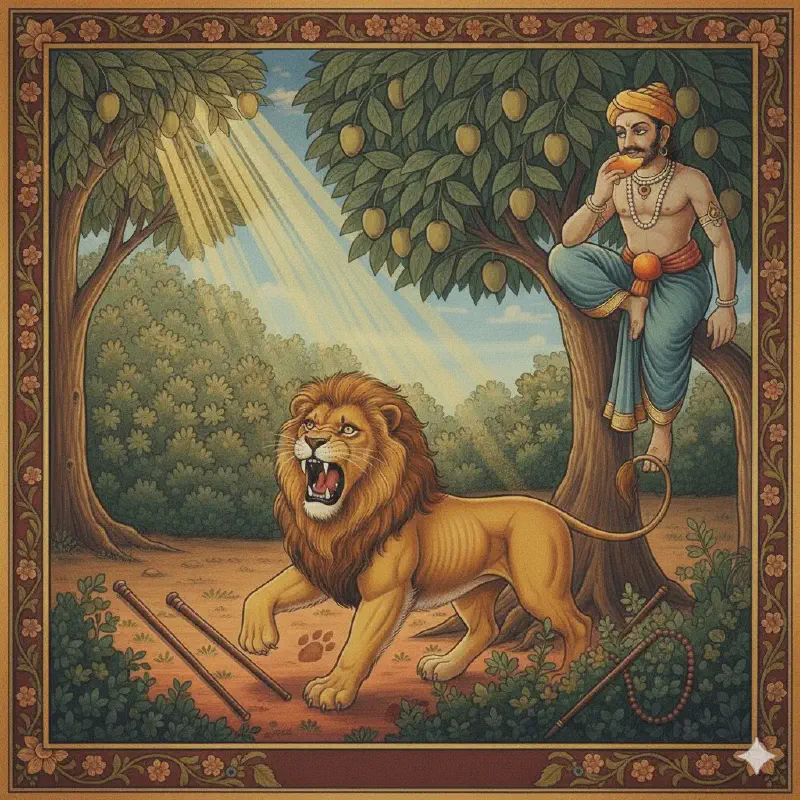
Once upon a time, in the ancient land of Bharat where even the crows recited Sanskrit and the monkeys debated philosophy, there lived four young Brahmin friends who had spent twelve years at the greatest gurukul in the kingdom.
Twelve years. Together. Surviving on thin gruel, thinner blankets, and the guru’s enthusiastic use of his cane.
Three of them — Vidyananda, Shastrika, and Mantraveer — had emerged as scholars of towering reputation. Vidyananda could reconstruct any creature’s skeleton from memory and had memorized every bone in existence, including seventeen that anatomists today still haven’t discovered. Shastrika could sculpt muscle and sinew and skin so perfectly that his creations were indistinguishable from the real thing — a talent that made him enormously popular at festivals and deeply unpopular with livestock. Mantraveer had mastered the sacred life-giving mantra, the prana-pratishtha, capable of breathing life itself into the inert. Gods occasionally called him for consultation.
The fourth friend was called Buddhisagar. Loosely translated: Ocean of Wisdom. His mother had been optimistic.
Buddhisagar had not, strictly speaking, excelled at the gurukul. He had passed. Narrowly. Repeatedly. He knew no great mantras, had mastered no spectacular science, and could not reconstruct so much as a moderately interesting beetle from its parts. What Buddhisagar possessed, in quantities his friends wholly lacked, was something the ancient texts call lokajnana — knowledge of the world as it actually, inconveniently, stubbornly is.
His friends called this “being simple.”
Buddhisagar called it “being alive.”
On the long road home after their graduation, walking through a dense forest fragrant with possibility and tiger droppings, the four friends came upon a clearing. There, bleached white by sun and season, lay the magnificent skeleton of a lion.
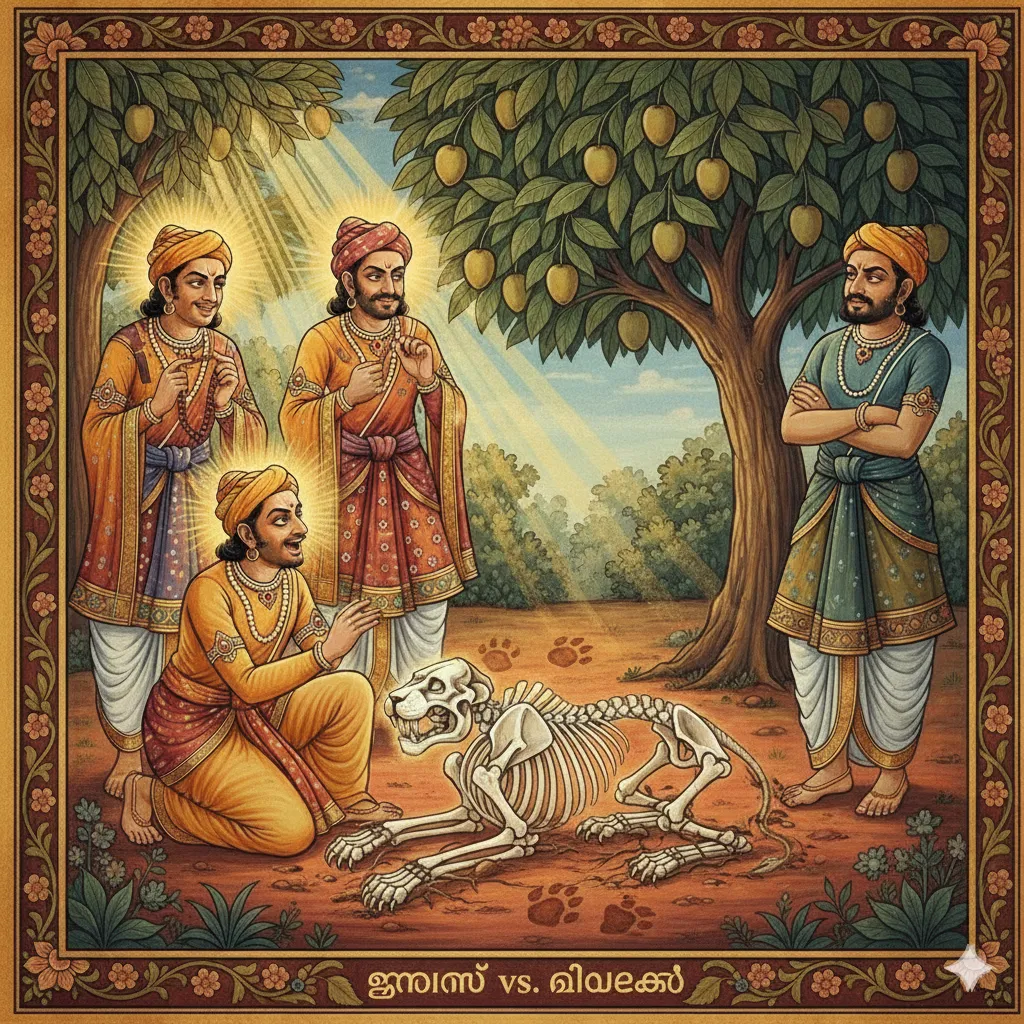
Vidyananda stopped as if struck by lightning. His eyes lit up with the dangerous brightness of a man who has just spotted an opportunity to show off.
“Brothers,” he announced, placing his hands on his hips in the manner of scholars everywhere who are about to say something catastrophic, “what fortune! Here lies a lion. Here stand we — masters of bone, flesh, and breath. Shall we not demonstrate, for the benefit of the cosmos, the full magnificence of our learning?”
Shastrika cracked his knuckles. “I have been waiting twelve years for exactly this moment.”
Mantraveer reverently dusted off his mantra beads. “Let it be written that on this day, three great scholars restored life where there was none.”
Buddhisagar looked at the skeleton. He looked at his friends. He looked at the skeleton again. He performed, in his head, a small but critical calculation — the sort that requires no advanced education whatsoever — and cleared his throat.
“Brothers,” he said carefully, “I have a thought.”
“Wonderful,” said Vidyananda, already arranging femurs. “Share it later.”
“It concerns the lion.”
“Yes, yes, it is a lion, well spotted, Buddhi.”
“Specifically, it concerns what lions do.”
Shastrika paused his muscle-sculpting. “They are majestic, noble—”
“They eat people,” said Buddhisagar. “Rather enthusiastically. Rather indiscriminately. Rather us-ly, if we’re standing right here when it wakes up.”
The three scholars exchanged the particular glance that brilliant people exchange when a lesser mind has wandered into an advanced conversation. It is a glance that says: how sweet, he is trying.
“Buddhi,” said Mantraveer with great patience, “this lion will be reborn into a state of gratitude. We are its benefactors. Its creators, practically speaking.”
“Lions,” said Buddhisagar, “are not known for gratitude. They are known for teeth.”
“You simply lack the philosophical framework to appreciate—”
“I appreciate it enormously. Which is why I am going to climb that tree.”
He pointed to a large, sturdy mango tree at the edge of the clearing, solid of trunk, generous of branch, entirely out of pouncing range.
His three friends stared at him. Then they laughed — the warm, affectionate laughter of the genuinely, catastrophically overconfident.
“Go then,” said Vidyananda, waving him away fondly. “Sit in your tree, little sparrow. We shall show you what knowledge can achieve.”
Buddhisagar, with the quiet dignity of a man who knows exactly what he knows and knows exactly what he doesn’t, climbed the tree. He settled on a comfortable branch. He found a mango. He began to eat it.
Below him, the greatest demonstration of scholarly achievement in the history of the forest commenced.
Vidyananda arranged the bones with extraordinary precision. Each vertebra in its proper place, each rib curved just so, the magnificent skull set at precisely the angle that said apex predator rather than museum exhibit. It was, genuinely, a masterwork. Even Buddhisagar, watching from above with his mango, had to admit it looked impressive.
Shastrika added the muscles, the tendons, the gleaming fur — golden and perfect, a lion so beautiful it would have moved lesser men to poetry. The whiskers were immaculate. The paws were enormous. The tail curled with aristocratic languor.
It looked, in every possible way, like a very large, very hungry lion.
“Buddhi,” called Shastrika from below, “are you sure you don’t want to come down and watch the final step?”
“Very sure,” said Buddhisagar, moving to a higher branch. “Remarkably, profoundly, cosmically sure.”
Mantraveer closed his eyes. He breathed deeply. He intoned the mantra — those ancient syllables of such power that the birds fell silent, the wind paused, and somewhere in the celestial realms a minor deity looked up from his paperwork with mild concern.
The lion’s chest rose.
Its eyes opened — amber, ancient, and absolutely, entirely unimpressed by scholarship.
It stood.
It shook its magnificent mane.
It looked at Vidyananda, Shastrika, and Mantraveer standing before it in a row, practically gift-wrapped, beaming with pride at their achievement.
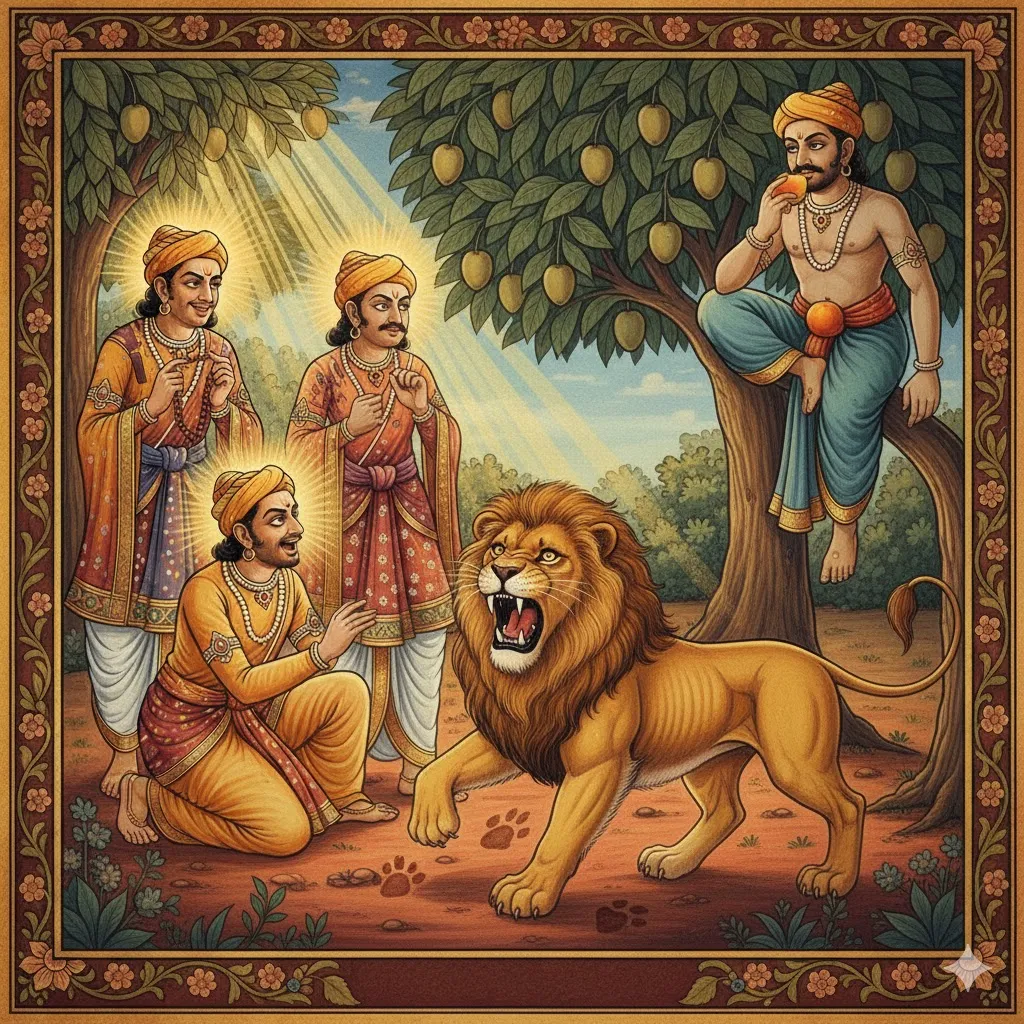
The lion did what lions do.
It did it with considerable thoroughness.
It did not take long. The lion, it must be said, was efficient if nothing else.
Afterwards, the lion — satisfied, full, and disinterested in mangoes or the man eating them — stretched magnificently and padded off into the forest, presumably to write a very different account of the afternoon.
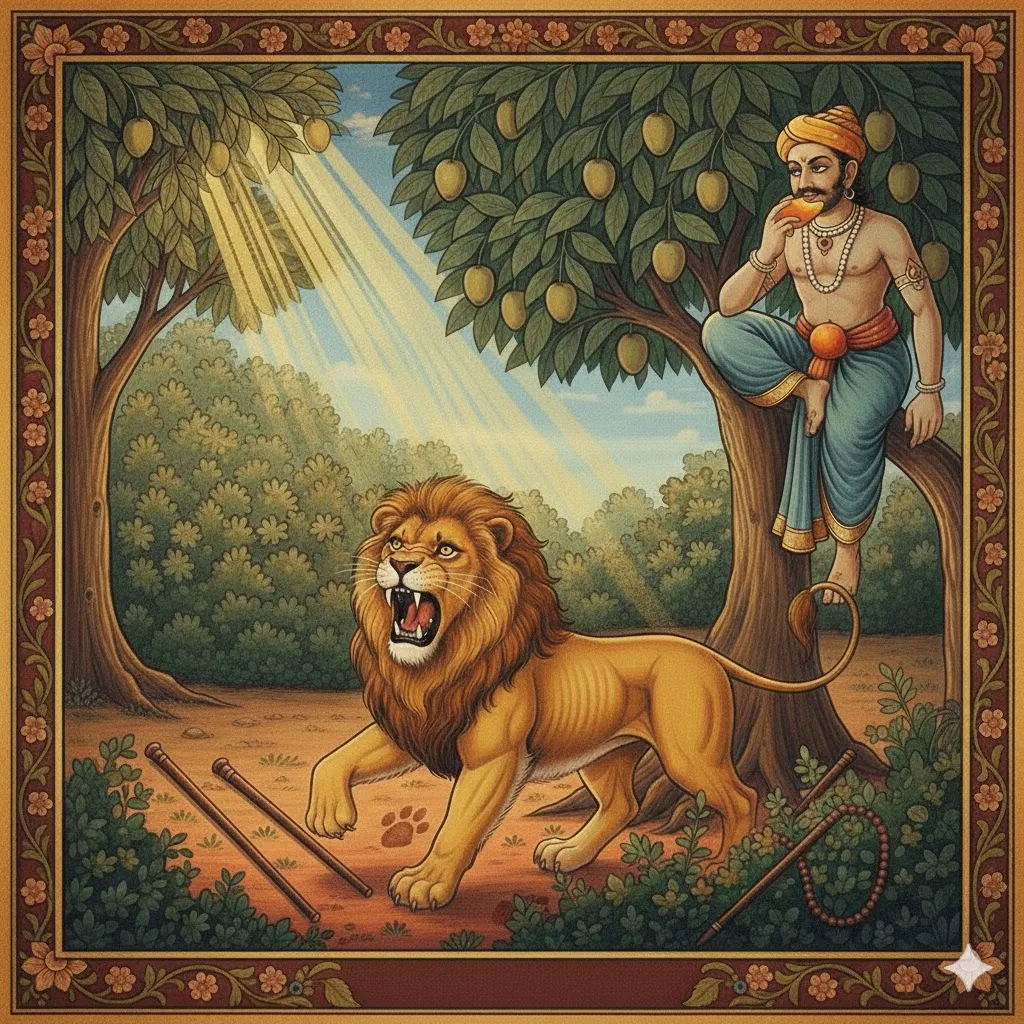
Buddhisagar sat in his tree for a respectful interval. Then he climbed down slowly, dusted off his dhoti, finished his mango, and walked home.
Alone. As he had calculated he would.
When he reached his village and people asked after his three brilliant companions, Buddhisagar would pause, look thoughtfully into the distance, and say:
“They made a lion.”
And when pressed for more detail, he would simply add:
“They were very good at what they knew. They were not good at what they didn’t know. Unfortunately, the lion did not distinguish between the two.”
And so it is written in the Panchatantra, and so it remains true in every age:
In a world full of people who know everything about something, make room, make generous, grateful, life-saving room, for the one person who knows something about everything.
He will be the one still standing.
Probably eating a mango.
— From the Stories from Bharat
“Where ancient wisdom wears modern shoes”
🙏 Namaste