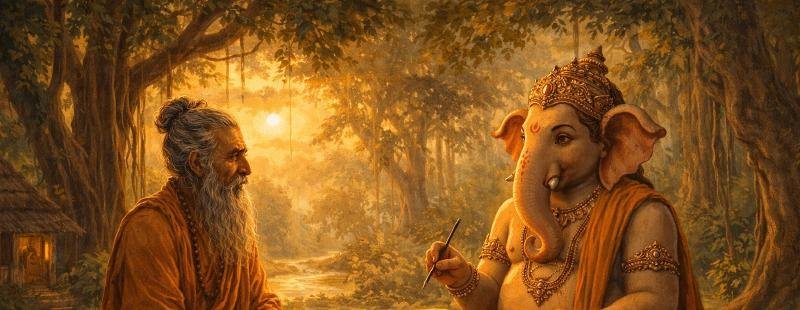
The great sage Veda Vyasa had a story burning inside him: the tale of a terrible war, the tangled lives that led to it, and the eternal questions of right and wrong that haunted everyone involved. It was going to be enormous. It was a story for the ages. It was a history of the Bharatas and all who lived in Jambudwipa, the ancient name for our land.
The old rishi had earned his name the hard way. Krishna Dvaipayana had spent decades collecting and organizing the sacred Vedas, traveling dusty roads across Bharata, teaching anyone who would listen. Now people simply called him Veda Vyasa; “the one who sorted out and compiled the Vedas.”
A practical name for a practical man.
But he was tired. His bones ached, his eyes weren’t what they used to be, and his hands cramped after writing just a few lines. He needed help.
So Vyasa closed his eyes and meditated on Brahma. “I need a scribe,” he said simply. “A good one.”
Brahma didn’t hesitate. “Ganesha. The elephant-headed one. Best writer in all the realms.”
Vyasa found Ganesha and made his request.
The portly god looked less than thrilled. He had temple dedications to attend, prayers to answer, obstacles to remove. Sitting around taking dictation from a chatty old sage? Not exactly his idea of a good time.
But you can’t say no to a revered rishi. So, Ganesha decided to make it interesting.
“Fine,” he said. “But I write fast. You’ll have to keep up. No pauses, no breaks, no ‘wait, let me think about that.’ The moment you stop, I’m done.”
Vyasa’s eyes twinkled. The old rishi had been dealing with gods and demons for years; he knew their ways and methods. “Agreed,” he said. “But here’s my condition: you only write what you actually understand. No mindless copying.”
Ganesha smiled. This might be fun after all.
They began.
Vyasa spoke and Ganesha’s pen flew across palm leaves like a bird in flight. The old sage quickly realized he’d underestimated his scribe; he couldn’t even pause for breath without risking Ganesha’s departure.
So Vyasa did what any clever teacher would do: he threw in a curveball, or as we say in cricketing terms, a googly.
Right in the middle of simple, flowing verses, he’d suddenly compose something magnificently complicated, puzzles wrapped in riddles, philosophy knotted like old rope.
Ganesha would stop, frown, and work it out. And Vyasa would catch his breath, sip some water, and plan his next moves.
This is why the Mahabharata reads the way it does, smooth flowing passages suddenly interrupted by brain-benders that make scholars argue for centuries.
But even gods have limits. Ganesha wrote so furiously that his reed pens kept breaking. When the last one snapped, there was a moment of crisis. The story couldn’t stop. Not now.
Without hesitation, Ganesha broke off one of his own tusks and kept writing.
They say this is why we see him with one tusk in so many images, why he’s called Ekadanta, “the one-tusked one.” A reminder, perhaps, that knowledge sometimes costs us something precious. And that it’s worth paying.
For three years they sat together: the tired old wanderer, and the determined god. When it was finally done, Vyasa’s disciples learned to sing the epic, carrying the story across the land.
And that’s how the world’s longest poem got written: one stubborn old man, one competitive deity, and a willingness to break your own tusk to finish what you started.
🙏 Namaste
